
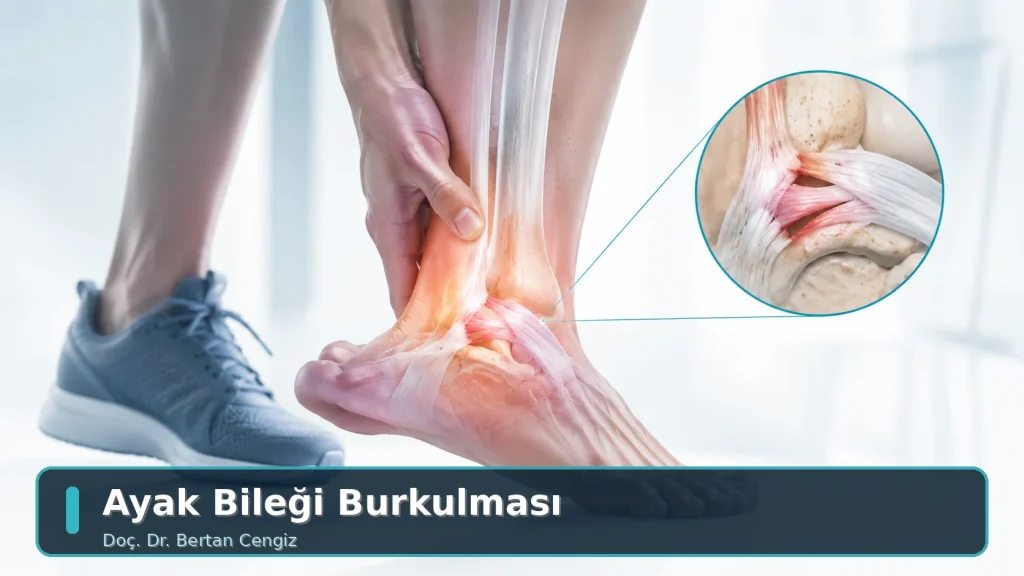
Ankle Sprain
An ankle sprain is the most common musculoskeletal injury. It usually occurs when the foot turns inwards, straining the outer collateral ligaments. Most sprains heal with appropriate care; however, inadequately rehabilitated sprains can recur and, in the longer term, set the stage for problems inside the joint.
The Ligaments of the Ankle
There are three main ligaments on the outer side of the ankle; the front one (ATFL) is the most frequently injured. On the inner side there is a strong ligament complex (deltoid). There are also the syndesmotic ligaments joining the shin bone and fibula; injury to these is called a “high ankle sprain” and takes longer to heal.

Grades
- Grade 1: stretching of the ligament. Mild pain and swelling; walking is usually possible.
- Grade 2: partial tear. Marked swelling, bruising, difficulty bearing weight.
- Grade 3: complete tear. Marked instability, widespread swelling and bruising.
Grade alone does not determine treatment; findings of instability, whether there is an accompanying fracture, and the person’s activity level are assessed together.
Fracture or Sprain?
Not every sprain requires an X-ray. Imaging is requested where a fracture is possible, in the following situations:
- Being unable to take four steps immediately after the injury or at presentation
- Marked bony tenderness at the back edge of the outer or inner ankle prominence
- Tenderness at certain bony points in the middle and outer part of the foot
- Obvious deformity
First Steps After an Acute Injury
What is done immediately after an injury can affect the course of healing. The generally recommended approach is protection, reducing load, ice, compression and elevation. This is not a definitive treatment; it is a first step to limit harm in the period before assessment.
- Protection: Stop the painful movement and loading; use support if needed.
- Ice: Apply through a thin cloth, several times a day and for short periods.
- Compression: Wrap an elastic bandage firmly enough to limit swelling, but not tight enough to restrict circulation.
- Elevation: Keep the injured area above heart level as much as possible.
- Early movement: After the first days, controlled movement within the limits of pain is recommended rather than complete rest.
Heat, massage and alcohol can increase bleeding and swelling in the early period and are therefore not recommended in the acute phase.
Treatment
The great majority of ankle sprains do not require surgery. The basis of treatment is controlled early movement and gradual loading; prolonged casting and complete immobility are not recommended in most cases today.
- The first days: protection, ice, compression, elevation; weight-bearing within the limits of pain.
- Movement: regaining ankle range of movement early.
- Strengthening: working the peroneal muscles on the outer side in particular.
- Balance work: single-leg stance and unstable-surface work — the most decisive step in preventing recurrence.
- Return to sport: gradual running, changes of direction and sport-specific movements.
A brace or taping can provide support, particularly in the early period and during return to sport; it does not replace balance and strength work.
Why Do Some Sprains Not Settle?
In a proportion of patients, pain, swelling or a sense of giving way continues even months later. The main reasons are:
- Inadequate rehabilitation: stopping the programme once the pain settles; the deficit in balance and strength not being closed.
- Chronic instability: the ligaments failing to provide sufficient tension after healing.
- Missed damage inside the joint: an osteochondral lesion in the cartilage of the talus.
- Impingement syndrome: soft tissue or bone impingement at the front or back of the ankle.
- A missed fracture: particularly small avulsion fragments.
In this situation a detailed assessment is carried out; where needed, ankle arthroscopy can both clarify the diagnosis and allow treatment. In recurrent instability, ligament repair or reconstruction surgery may be considered.
Return to Sport
The decision to return to sport is made with measurable goals, not with the calendar. Time alone is not a sufficient criterion; returning early increases the risk of re-injury.
- Full, pain-free range of movement
- Muscle strength and endurance close to the uninjured side
- Regained balance and position sense (proprioception)
- Ability to perform sport-specific movements without pain and under control
- The athlete feeling ready — psychological readiness is also a criterion
These criteria are assessed by your physician and physiotherapist. Outcomes vary from person to person; no guarantee of a specific timeframe or result is given on this page.
Preventing Recurrence
- Continuing balance (proprioception) work even after the pain has settled
- Making peroneal strengthening a permanent part of the programme
- Using footwear suited to the surface and the discipline
- Making use of a brace or taping support during higher-risk periods
- Planning return to sport with functional criteria
When to Seek Medical Help Without Delay
- Being unable to bear any weight on the injured area, or unable to take a few steps
- Obvious deformity (a bone or joint appearing out of place)
- Rapidly developing, tense and painful swelling
- Bluish discolouration, paleness, coldness or increasing numbness in the fingers or toes
- Hearing a “snap/pop” followed by loss of strength
- Joint redness and warmth together with fever
- Obvious deformity of the ankle — this may indicate a dislocation or fracture
These findings require urgent assessment. Outside office hours, go to the nearest emergency department.
Frequently Asked Questions
Do I need an X-ray for a sprain?
Not for every sprain. Imaging is requested where a fracture is possible: if you cannot take four steps after the injury, if there is marked bony tenderness at the back edge of the ankle prominences, or if there is an obvious deformity. This assessment is made by examination.
Does a sprained ankle need a cast?
Prolonged casting is not recommended for most sprains. Controlled early movement and gradual loading give better results. A cast or brace is used in selected situations such as marked instability, fracture or syndesmotic injury.
When can I start walking?
Weight-bearing is generally begun early, within the limits of pain, with crutch support if needed. Complete immobility is not recommended. Your individual plan is determined after examination.
My ankle keeps giving way — what should I do?
Recurrent sprains usually indicate that the deficit in balance and muscle strength has not been closed, or that chronic laxity has developed in the ligaments. There may also be a missed cartilage lesion inside the joint. Detailed assessment and a targeted programme are needed; in resistant cases surgical options are considered.
Does wearing a brace weaken my ankle?
Used appropriately, a brace does not weaken the muscles. However, relying on the brace and neglecting balance and strength work removes the protection. A brace is a support, not the treatment itself.
Are massage and heat helpful after a sprain?
In the first days heat, massage and alcohol can increase bleeding and swelling and are therefore not recommended. Once the acute phase has passed, these may be considered on your physician’s advice.
Academic Work
Assoc. Prof. Bertan Cengiz, MD has scientific work published in national and international peer-reviewed journals in the field of foot and ankle surgery and related areas. The publication list and verifiable academic sources are available on the Publications page.
Related Pages
The information on this page is for general guidance and does not replace an in-person medical examination. Diagnosis and treatment require a physician’s clinical assessment. Outcomes of any treatment or surgical intervention may vary from person to person; no guarantee of a specific result or timeframe is given on this page.