
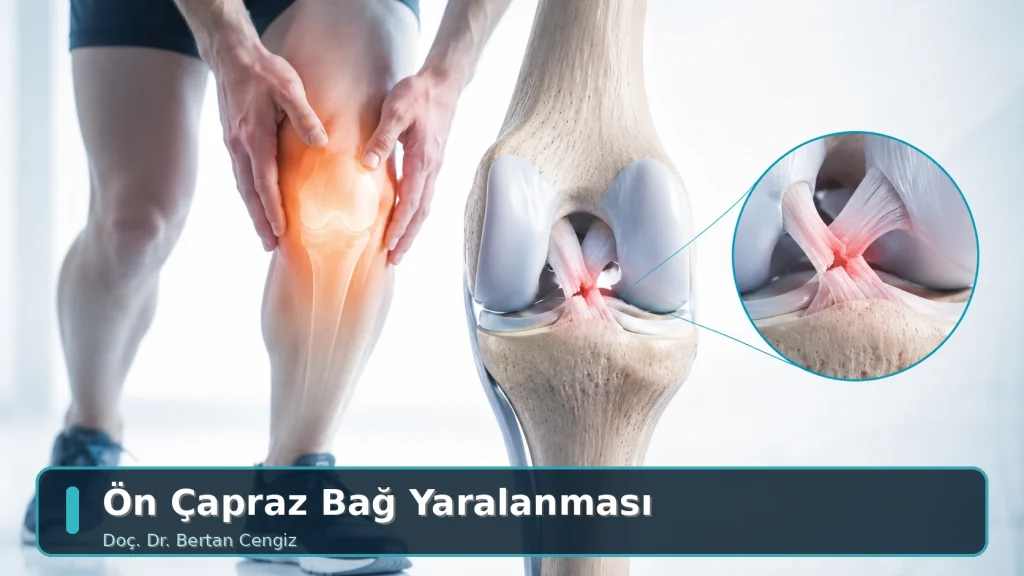
Anterior Cruciate Ligament (ACL) Injury
The anterior cruciate ligament (ACL) is the main stabiliser inside the knee, preventing the shin bone from sliding forwards and limiting excessive rotation. It is usually injured by a non-contact mechanism — during a sudden stop, a change of direction, or a poor landing after a jump. It is common in football, basketball, volleyball and skiing.
What Does the Anterior Cruciate Ligament Do?
Two ligaments cross inside the knee joint. The anterior cruciate ligament limits forward sliding of the shin bone relative to the thigh bone and controls the knee during rotational movements. When this ligament loses its function, the knee gives way, particularly during pivoting and sudden stops. Over time these episodes can lead to meniscal and cartilage damage.

How Does It Get Injured?
A significant proportion of ACL injuries occur without contact; nobody collides with the athlete. Typical mechanisms are:
- A sudden stop and change of direction while running (a cutting movement)
- A poor landing after a jump in which the knee collapses inwards
- The body rotating while the foot is fixed
- A blow to the knee from behind or the side (contact mechanism)
ACL injury is reported more frequently in female athletes; muscle strength balance, landing technique and anatomical differences are considered to play a role. Neuromuscular training programmes have been shown to help reduce this risk.
Symptoms
- A “pop” heard at the moment of injury
- Rapidly developing swelling (usually within the first hours) — indicating bleeding into the joint
- A sense of the knee giving way and feeling insecure
- Pain too severe to bear full weight
- Restriction of range of movement
Rapidly developing swelling is an important warning. In knees that swell markedly within hours of injury, the likelihood of serious damage to structures inside the joint is high.
First Steps After an Acute Injury
What is done immediately after an injury can affect the course of healing. The generally recommended approach is protection, reducing load, ice, compression and elevation. This is not a definitive treatment; it is a first step to limit harm in the period before assessment.
- Protection: Stop the painful movement and loading; use support if needed.
- Ice: Apply through a thin cloth, several times a day and for short periods.
- Compression: Wrap an elastic bandage firmly enough to limit swelling, but not tight enough to restrict circulation.
- Elevation: Keep the injured area above heart level as much as possible.
- Early movement: After the first days, controlled movement within the limits of pain is recommended rather than complete rest.
Heat, massage and alcohol can increase bleeding and swelling in the early period and are therefore not recommended in the acute phase.
Diagnosis
- History: the mechanism of injury, whether a sound was heard, how quickly swelling developed, whether play could continue.
- Physical examination: the function of the ligament is assessed with the Lachman test, anterior drawer test and pivot shift test.
- X-ray: to check for an accompanying fracture.
- MRI: shows the state of the ligament and any accompanying meniscal or cartilage injury.
ACL injuries are frequently accompanied by a meniscus tear, cartilage damage or collateral ligament injury. Assessment is therefore not limited to the ligament alone.
Treatment: Not Everyone Needs Surgery
When the ACL is torn, the treatment decision is not automatic. There are two paths, and the choice is made individually:
Non-surgical treatment
In people who do not experience the knee giving way, who take part in low-to-moderate activity and who do not aim to return to sports involving pivoting and cutting, good function can be achieved with a comprehensive strengthening and neuromuscular control programme. In this group the strength of the front and back thigh muscles is decisive.
Surgical treatment (ACL reconstruction)
A torn ACL cannot be repaired with sutures; instead a graft prepared from the person’s own tissue is used. The graft is passed through tunnels made in the bone, placed at the anatomical position of the ligament and fixed. The procedure is performed with arthroscopic (keyhole) technique.
Surgery is considered more often in people who wish to return to sports involving pivoting and cutting, who experience the knee giving way in daily life, who have an accompanying repairable meniscus tear, and who are young and active. Graft choice (hamstring, patellar tendon or quadriceps tendon) is planned according to age, discipline and accompanying injuries.
Timing of Surgery
Surgery is usually not urgent. It is preferable to wait for the swelling to settle, for full straightening (extension) to be achieved and for the quadriceps to be activated. Surgery on a swollen, stiff knee can increase the risk of restricted movement afterwards. For this reason a rehabilitation programme is also carried out before the operation (“prehabilitation”).
The Postoperative Period
Rehabilitation is the most decisive part of the outcome in ACL surgery. The programme generally follows this order:
- Control of swelling, achieving full extension and activating the quadriceps
- Completing range of movement and normalising gait
- Gradual strengthening
- Balance, jump–landing control and progression to running
- Sport-specific movements and controlled contact work
Biological maturation of the graft takes time; feeling well does not mean the graft is ready. Return to sport is therefore assessed with functional testing.
Return to Sport
The decision to return to sport is made with measurable goals, not with the calendar. Time alone is not a sufficient criterion; returning early increases the risk of re-injury.
- Full, pain-free range of movement
- Muscle strength and endurance close to the uninjured side
- Regained balance and position sense (proprioception)
- Ability to perform sport-specific movements without pain and under control
- The athlete feeling ready — psychological readiness is also a criterion
These criteria are assessed by your physician and physiotherapist. Outcomes vary from person to person; no guarantee of a specific timeframe or result is given on this page.
When to Seek Medical Help Without Delay
- Being unable to bear any weight on the injured area, or unable to take a few steps
- Obvious deformity (a bone or joint appearing out of place)
- Rapidly developing, tense and painful swelling
- Bluish discolouration, paleness, coldness or increasing numbness in the fingers or toes
- Hearing a “snap/pop” followed by loss of strength
- Joint redness and warmth together with fever
- The knee remaining locked and unable to straighten at all
These findings require urgent assessment. Outside office hours, go to the nearest emergency department.
Frequently Asked Questions
Is surgery always needed when the ACL is torn?
No. The decision is made according to your age, activity level, whether the knee gives way, the sport you aim to return to, and any accompanying meniscal or cartilage injury. Surgery is recommended more often for those who wish to return to pivoting and cutting sports and who experience giving way; in some people adequate function can be achieved with a strengthening programme.
Can the torn ligament not simply be stitched?
When the ACL tears, its ends usually do not come together in a way that allows healing. The standard approach is therefore to reconstruct the ligament with a graft prepared from the person’s own tissue.
Do I need the operation immediately?
In most cases no. It is preferable first to allow the swelling to settle, achieve full extension and restore muscle activation. Surgery on a swollen, stiff knee increases the risk of restricted movement afterwards. Situations such as locking can change this sequence.
When can I return to sport after the operation?
This varies with the individual and the discipline. The decision is made not by the calendar but by criteria: pain-free full movement, muscle strength close to the uninjured side, jump–landing control and the ability to perform sport-specific movements safely. Returning early increases the risk of re-injury.
My ligament is torn but I have no pain — is something wrong?
The absence of pain does not mean the ligament is intact. In ACL insufficiency the main problem is not pain but giving way during rotational movements. Repeated episodes of giving way can lead to meniscal and cartilage damage over time, so assessment is needed.
Would wearing a brace be enough?
A brace may increase confidence in some people, but it does not replace the function of a torn ligament and is not a sufficient treatment on its own. What matters is muscle strength and movement control.
Academic Work
Assoc. Prof. Bertan Cengiz, MD has scientific work published in national and international peer-reviewed journals in the field of anterior cruciate ligament reconstruction and knee arthroscopy and related areas. The publication list and verifiable academic sources are available on the Publications page.
Related Pages
The information on this page is for general guidance and does not replace an in-person medical examination. Diagnosis and treatment require a physician’s clinical assessment. Outcomes of any treatment or surgical intervention may vary from person to person; no guarantee of a specific result or timeframe is given on this page.