
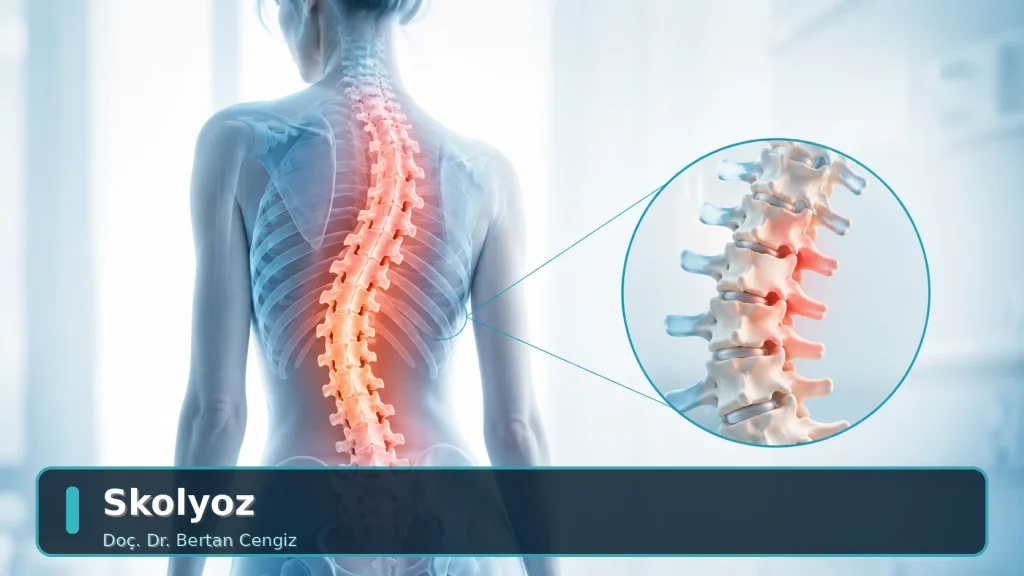
Scoliosis (Curvature of the Spine)
Scoliosis is a sideways curvature of the spine seen from the front, together with rotation of the spine around its own axis. Because of this three-dimensional nature, scoliosis is not a simple «postural problem». The degree of curvature, the patient’s age and remaining growth potential are the three factors that determine follow-up and treatment.
Types of Scoliosis
- Idiopathic scoliosis: the most common type; no clear cause can be identified. Classified by age at onset as infantile, juvenile and adolescent.
- Congenital scoliosis: due to differences in the development of the spinal bones before birth.
- Neuromuscular scoliosis: accompanies muscle and nervous system conditions.
- Degenerative (adult) scoliosis: develops in later life as spinal structures wear; it usually presents with back pain and leg symptoms.
The most frequently encountered group is adolescent idiopathic scoliosis, and it is generally painless. For that reason it is often noticed by the family or at a school screening.

How Is It Noticed?
The following findings are clues that families may notice:
- Shoulders sitting at different heights
- One shoulder blade appearing more prominent
- Asymmetry of the waist creases and hip level
- One side of the back rising noticeably on bending forward (a rib prominence)
- Clothes hanging to one side; trouser legs appearing different
The forward bending test (Adams test) is a simple observation that can be done at home; however, it does not make the diagnosis — it only indicates the need for assessment.
Diagnosis and Measurement
- History: when it was noticed, family history of scoliosis, growth rate, and in girls the onset of periods (which gives information about remaining growth).
- Physical examination: shoulder–hip balance, forward bending test, trunk balance and neurological examination.
- Standing whole-spine X-ray: the degree of curvature is measured with the Cobb angle. Curves above 10 degrees are used for the diagnosis of scoliosis.
- Assessment of growth: remaining growth potential is estimated with measures such as the Risser stage; this is critical in determining the risk of progression.
- MRI: requested with atypical findings, neurological signs or early age at onset.
Observation or Treatment?
This decision depends on three factors: the degree of curvature, the patient’s age and remaining growth potential. A curve may progress in a growing child, whereas the same degree is generally stable in someone who has finished growing.
Observation
For low-grade curves, follow-up is carried out with examination at intervals and imaging where needed. The aim is to detect any progression early. The interval is set according to growth rate.
Brace treatment
In patients who are still growing and have a moderate curve, a brace is used to slow or halt progression. The aim of a brace is not to correct the existing curve but to prevent progression. Its effectiveness depends largely on adherence to daily wearing time; the involvement of the family and the child is therefore decisive.
An exercise programme accompanies brace treatment. Exercise alone does not correct the curve, but it supports trunk muscle strength, posture and breathing capacity.
Surgical treatment
Surgery is considered for high-grade, progressive curves that cannot be controlled with a brace. The aims are to correct the curve within safe limits, restore trunk balance and stop progression. In early-onset scoliosis, systems that allow continued growth may be used.
The decision weighs the degree and type of curve, the rate of progression, trunk balance, respiratory function and the patient’s age. Outcomes vary from person to person and the decision is taken after detailed discussion with the family.
Common Misconceptions
- “A heavy bag causes scoliosis” — a heavy bag may cause back pain, but it is not the cause of idiopathic scoliosis.
- “Sitting badly causes scoliosis” — posture may increase symptoms, but it does not cause a structural curve.
- “Exercise will correct the curve” — exercise is supportive; it does not on its own correct a structural curve.
- “No pain means no scoliosis” — adolescent idiopathic scoliosis is generally painless, which is why it can be missed.
When Should You Seek Assessment?
- If you notice asymmetry of the shoulders, shoulder blades or waist
- If one side of the back rises noticeably on bending forward
- If there is a family history of scoliosis and your child is in a rapid growth phase
- If you observe an increase in a previously identified curve
- If back pain is accompanied by night pain or neurological symptoms
When to Seek Medical Help Without Delay
- Loss of strength in the legs, numbness or difficulty walking
- A change in bladder or bowel control
- Back pain that wakes you at night and does not settle with rest
- Back pain together with fever and weight loss
These findings require urgent assessment. Outside office hours, go to the nearest emergency department.
Frequently Asked Questions
Does scoliosis progress?
The risk of progression depends most on remaining growth potential and the degree of the curve. The risk is high during rapid growth; after growth is complete, low-grade curves are generally stable. Follow-up intervals are therefore planned according to growth.
Does wearing a brace correct the curve?
The aim of a brace is not to correct the existing curve but to prevent it progressing while growth continues. Success depends largely on adherence to daily wearing time. In patients who have finished growing, no benefit from a brace is expected.
Will exercise or swimming cure scoliosis?
Exercise supports trunk muscle strength, posture and breathing capacity and is recommended for general health. However, it does not on its own correct a structural curve. Swimming is a beneficial activity, not a treatment for scoliosis.
My child has scoliosis — can they do sport?
In most cases sport is not restricted; on the contrary it is encouraged. If restriction is needed, it is determined by the physician according to the degree of curve, the stage of treatment and the type of sport.
Is scoliosis hereditary?
It is more common in those with a family history, and genetic predisposition plays a role. However, it is not a simple single-gene inheritance. Where there is a family history, follow-up during the growth period is recommended.
Is movement restricted after surgery?
In surgery a section of the spine is fused, and movement in that region decreases. Daily activities can generally be maintained. Expectations, the method to be used and the region to be fused are discussed in detail before surgery.
Academic Work
Assoc. Prof. Bertan Cengiz, MD has scientific work published in national and international peer-reviewed journals in the field of scoliosis surgery and spinal deformity and related areas. The publication list and verifiable academic sources are available on the Publications page.
Related Pages
- Spinal Disorders and Scoliosis
- Lumbar Disc Herniation
- Spinal Stenosis (Narrow Canal)
- Cervical Disc Herniation (Neck Hernia)
- Paediatric Orthopaedics
The information on this page is for general guidance and does not replace an in-person medical examination. Diagnosis and treatment require a physician’s clinical assessment. Outcomes of any treatment or surgical intervention may vary from person to person; no guarantee of a specific result or timeframe is given on this page.