
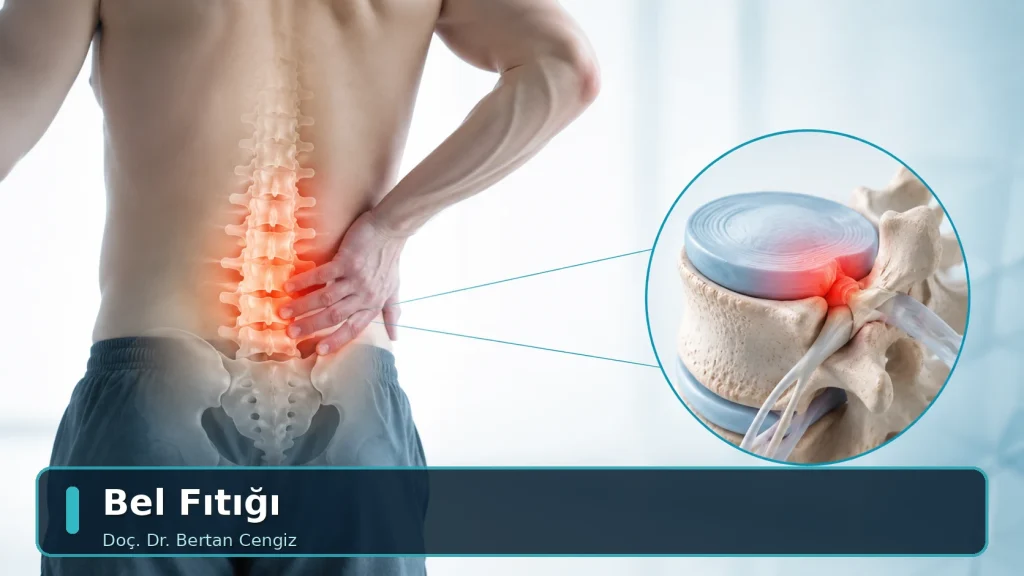
Lumbar Disc Herniation
A lumbar disc herniation occurs when the outer ring of a disc between the vertebrae wears and the gel-like core inside protrudes, most often compressing a nerve root. Pain radiating into the leg (sciatica) is the typical finding. An important fact is this: the great majority of lumbar disc herniations resolve without surgery.
What Is a Disc and What Happens?
The discs between the vertebrae are cushions that distribute load and allow movement. There is a fibrous ring (annulus) on the outside and a gel-like core (nucleus) inside. With age and repeated loading, wear develops in the outer ring; the core can protrude through this weak point and press on the spinal canal or the space where the nerve root exits.
The cause of pain is not only mechanical compression; the chemical inflammatory response produced around the protruding disc material also irritates the nerve root. This explains why symptoms can settle with medication and time.

Symptoms
- Pain radiating from the back into the buttock and leg (sciatica) — usually one-sided
- Pain increased by coughing, sneezing and straining
- Symptoms worsened by sitting for long periods and bending forwards
- Numbness or tingling in the leg or foot
- Weakness when lifting the ankle or big toe
- In some patients leg pain predominates over back pain
The area to which the pain radiates gives information about which nerve root is affected; it is therefore important to describe exactly where your symptoms spread.
Diagnosis
- History: onset of pain, area of radiation, aggravating and relieving factors, numbness and weakness, bladder and bowel symptoms.
- Neurological examination: muscle strength, reflexes, sensory examination and the straight leg raise test.
- X-ray: does not show the disc; requested to assess alignment, slippage and the bony structures.
- MRI: the principal method showing the disc, nerve root and spinal canal.
Important: disc protrusion can be found on MRI in a significant proportion of people with no symptoms at all, and this proportion rises with age. An MRI finding therefore does not on its own determine treatment — symptoms, examination findings and imaging are interpreted together.
Treatment
Non-surgical treatment (first choice)
Where there are no red-flag findings and no progressive weakness, the first approach is not surgical. In the great majority of patients symptoms settle markedly within weeks.
- Staying active: bed rest is not recommended; maintaining daily movement as tolerated speeds recovery.
- Pain management — the choice and duration of medication is determined by your physician
- Physiotherapy and an exercise programme targeting the trunk (core) muscles
- Reviewing daily life and working arrangements
- Epidural injection treatments in selected cases
Related article: The First 48 Hours of Back Pain: What to Do and What to Avoid
Surgical treatment
Surgery is considered in the following situations:
- Progressive or marked muscle weakness
- Leg pain that restricts daily life and persists despite an adequate period of non-surgical treatment
- Cauda equina syndrome — requires emergency surgery (see the warning section below)
The procedure performed is generally removal of the disc fragment pressing on the nerve root (microdiscectomy). The decision weighs the duration and severity of symptoms, neurological findings, the agreement between MRI and examination, and the patient’s daily requirements.
Protecting Your Back
- When lifting, bend your knees, keep the load close to your body and do not twist while lifting
- Do not sit in the same position for long; stand up and move every 30–45 minutes
- Exercise regularly to strengthen the trunk and hip muscles
- Maintain weight control; excess weight increases the load on the back
- Stopping smoking has a favourable effect on disc nutrition
When Should You Seek Assessment?
- If pain radiating into the leg has lasted several weeks
- If numbness or tingling is spreading
- If you have difficulty lifting your foot or are catching your slipper
- If pain interrupts your sleep at night
- If symptoms are increasing despite medication and physiotherapy
When to Seek Medical Help Without Delay
- Loss of bladder or bowel control, or an inability to pass urine
- Numbness around the anus and inner thighs (cauda equina syndrome) — may require emergency surgery
- Weakness developing in both legs at once
- Rapidly progressing foot drop or marked muscle weakness
- Night pain together with fever, weight loss or a history of cancer
- Severe back pain after an injury
These findings require urgent assessment. Outside office hours, go to the nearest emergency department.
Frequently Asked Questions
Can a disc herniation settle without surgery?
Yes; in the great majority of patients symptoms settle without surgery. The protruding disc material can shrink over time and the inflammatory response decreases. Surgery is considered for progressive weakness, cauda equina syndrome, or resistant pain not responding to an adequate period of treatment.
The MRI shows a herniation — must I have surgery?
No — an MRI finding is not on its own a reason to operate. Disc protrusion is common even in people with no symptoms. The decision is based on examination findings, the severity and duration of symptoms, and whether imaging supports them.
Is bed rest necessary?
Prolonged bed rest is not recommended; it reduces muscle strength and delays recovery. In the first days it is recommended to stay as active as pain allows and to return gradually to daily activity.
Can the herniation recur after surgery?
Re-herniation at the same level is possible; how often varies from person to person. To reduce the risk, weight control, strengthening of the trunk muscles, correct lifting technique and stopping smoking are recommended.
Will the numbness in my leg be permanent?
Recovery of numbness depends on the duration and severity of nerve compression. It settles in most patients with treatment; recovery may be slower where compression has been prolonged and severe. If weakness is present, assessment should not be delayed.
Can I do sport?
In the acute phase, movements that increase pain are avoided; however, activities such as walking and swimming are generally recommended early. Return to weight training is planned gradually and technique matters.
Academic Work
Assoc. Prof. Bertan Cengiz, MD has scientific work published in national and international peer-reviewed journals in the field of spinal surgery and degenerative spinal disease and related areas. The publication list and verifiable academic sources are available on the Publications page.
Related Pages
- Spinal Disorders and Scoliosis
- Spinal Stenosis (Narrow Canal)
- Cervical Disc Herniation (Neck Hernia)
- Scoliosis (Curvature of the Spine)
- The First 48 Hours of Back Pain: What to Do and What to Avoid
The information on this page is for general guidance and does not replace an in-person medical examination. Diagnosis and treatment require a physician’s clinical assessment. Outcomes of any treatment or surgical intervention may vary from person to person; no guarantee of a specific result or timeframe is given on this page.