
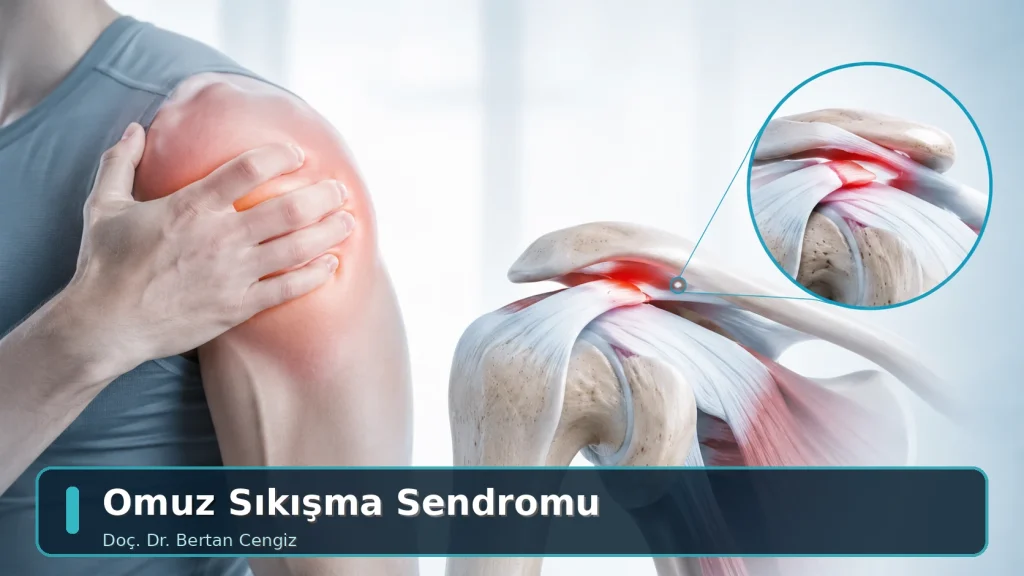
Shoulder Impingement Syndrome
Shoulder impingement syndrome is a pattern of pain arising when the rotator cuff tendons and the bursa above them are compressed beneath the roof of the shoulder as the arm is raised. It is common in occupations involving overhead work and in overhead sports.
Why Does Impingement Occur?
When the arm is raised to the side and upwards, the rotator cuff tendons pass through the narrow space between the roof-like projection of the shoulder blade (the acromion) and the head of the arm bone. Narrowing of this space, or thickening of the tendon, leads to friction and pain.
The causes of narrowing fall into two groups:
- Structural (extrinsic) causes: the shape of the acromion, development of a bony spur, osteoarthritis of the acromioclavicular joint.
- Functional (intrinsic) causes: impaired control of shoulder blade movement, weakness of the rotator cuff muscles, tightness of the posterior capsule, poor posture.
Functional causes predominate particularly in younger patients and matter because they can be corrected with exercise.

Symptoms
- Pain becoming marked while raising the arm between roughly 60 and 120 degrees (the painful arc)
- Pain over the outer aspect of the shoulder radiating into the upper arm
- Difficulty with overhead movements (reaching a shelf, painting, serving in tennis)
- Night pain and being unable to lie on the affected side
- Difficulty reaching behind the back or into a back pocket
Diagnosis
- History: occupational and sporting overhead activity, the angle at which pain appears, night pain.
- Physical examination: the painful arc, Neer and Hawkins impingement tests, rotator cuff strength tests, assessment of shoulder blade movement.
- X-ray: to see the shape of the acromion, bony spurs and calcification.
- MRI: requested to show tendon tears, bursal inflammation or accompanying problems.
Impingement syndrome, rotator cuff tear and frozen shoulder can give similar symptoms; the differential diagnosis is made by examination. In frozen shoulder passive movement is also restricted, whereas in impingement passive movement is generally preserved.
Treatment
Exercise-based treatment
The first and most effective step in treating shoulder impingement is a structured exercise programme. It covers rotator cuff strengthening, shoulder blade control, posterior capsule stretching and postural correction. Results take weeks; maintaining the programme regularly is decisive.
- Temporarily reducing the overhead activities that trigger pain
- Strengthening the rotator cuff and the muscles around the shoulder blade
- Posterior capsule stretching exercises
- Reviewing the working environment and movement patterns
- Pain management; subacromial injection in selected cases
Surgery
Surgery is considered in cases that persist for a long time and do not respond sufficiently to a regularly applied exercise programme. Using arthroscopic technique, the narrowed space is widened, inflamed bursa is removed and any bony prominence is corrected. An accompanying rotator cuff tear can be repaired in the same session.
The decision to operate is not taken hastily: where there is no structural narrowing and the cause is purely functional, the expected contribution of surgery is limited.
What Helps in Daily Life?
- Breaking up long periods of overhead work and adjusting working height where possible
- Not carrying heavy loads above shoulder height
- Avoiding a slumped, forward-shoulder posture at a desk or computer
- Not lying on the affected side; supporting the arm with a pillow
- Continuing the exercise programme after the pain has settled
When Should You Seek Assessment?
- If you have recurrent pain when raising the arm to a particular angle
- If night pain interrupts your sleep
- If overhead work or sport is being restricted
- If loss of strength accompanies the pain (a tear should be assessed)
- If there has been no improvement for months despite an exercise programme
When to Seek Medical Help Without Delay
- Being unable to raise the arm after an injury, or obvious deformity
- Loss of strength in the arm together with numbness and tingling
- Redness, swelling and severe pain in the shoulder together with fever
These findings require urgent assessment. Outside office hours, go to the nearest emergency department.
Frequently Asked Questions
How do we tell impingement from a rotator cuff tear?
The two can also occur together. In general pain predominates in impingement, whereas a tear is accompanied by marked loss of strength. The distinction is made with examination tests and, where needed, MRI.
Can it settle without surgery?
In a significant proportion of cases a regularly applied exercise programme brings marked improvement. Surgery is considered where symptoms persist for a long time and do not respond to that programme.
If the exercises hurt, should I continue?
Mild, temporary discomfort can be expected; however, pain that increases and carries over to the next day means the programme is too demanding. Load and repetitions should be reduced and the programme reviewed with your physician or physiotherapist.
Is a subacromial injection a treatment?
An injection is not a treatment on its own; its aim is to reduce pain so that an exercise programme can be started and maintained. Repeated injections are assessed with care.
Should I stop doing sport?
It is generally not necessary to stop altogether; the overhead movements that trigger pain are temporarily reduced and fitness is maintained with alternative work. A graded return is planned with your physician.
Does posture affect my shoulder?
Yes. With slumped shoulders and a rounded upper back, movement of the shoulder blade is impaired and the space narrows. Postural and trunk work is therefore added to the treatment programme.
Academic Work
Assoc. Prof. Bertan Cengiz, MD has scientific work published in national and international peer-reviewed journals in the field of shoulder arthroscopy and upper limb surgery and related areas. The publication list and verifiable academic sources are available on the Publications page.
Related Pages
- Shoulder Arthroscopy
- Rotator Cuff Tear
- Frozen Shoulder (Adhesive Capsulitis)
- Shoulder and Upper Extremity
- Shoulder Dislocation and Instability
The information on this page is for general guidance and does not replace an in-person medical examination. Diagnosis and treatment require a physician’s clinical assessment. Outcomes of any treatment or surgical intervention may vary from person to person; no guarantee of a specific result or timeframe is given on this page.