
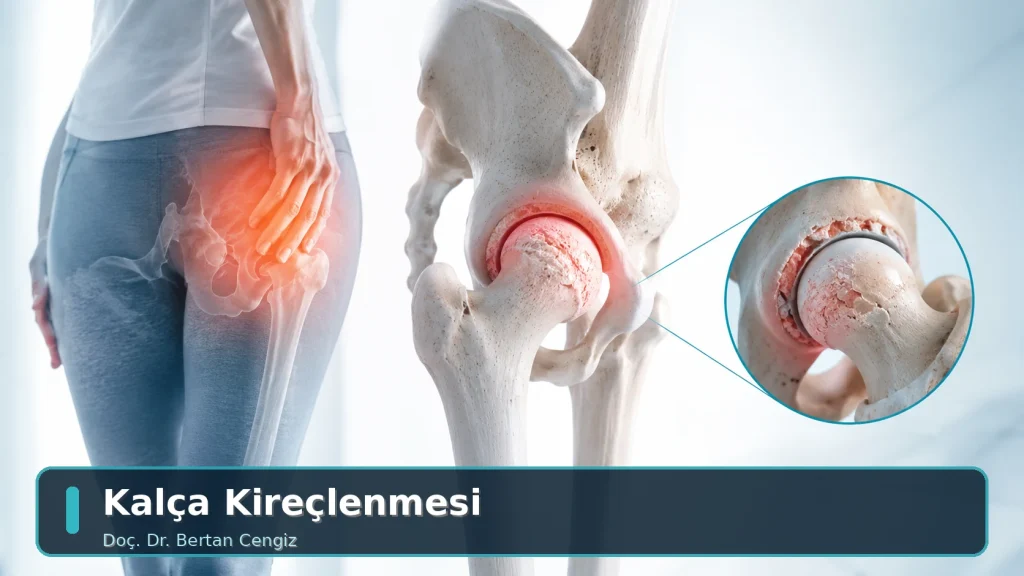
Hip Osteoarthritis (Coxarthrosis)
Hip osteoarthritis (coxarthrosis) is the thinning of cartilage in the hip joint together with change throughout the joint. Because the hip is a deep joint, symptoms are most often felt in the groin; for this reason it can be confused with lumbar disc problems and groin conditions.
What Happens in the Hip Joint?
The hip is a ball-and-socket joint formed by the head of the thigh bone sitting in the socket of the pelvis. As cartilage thins the joint space narrows, bony prominences may form at the edges and range of movement decreases. Loss of movement in the hip is usually noticed first in internal rotation — patients describe this as difficulty putting on socks or tying shoelaces.
Osteoarthritis may be primary (without an identifiable cause) or secondary — developing after developmental dysplasia of the hip, femoroacetabular impingement, childhood hip conditions, a hip fracture or avascular necrosis.

Symptoms
- Pain in the groin — patients often describe it by placing the hand in a “C” shape over the side of the hip
- Pain radiating to the front of the thigh and sometimes to the knee (the hip must always be assessed in a patient presenting with knee pain)
- Difficulty putting on socks, tying shoelaces and getting in and out of a car
- Morning stiffness and pain on the first steps after sitting for a long time
- A shorter walking distance and limping
- A sense of leg length difference in later stages
Diagnosis
- History: the site of pain, which movements aggravate it, walking distance, night pain.
- Physical examination: hip range of movement (particularly internal rotation), gait, leg length difference and strength of the surrounding muscles.
- X-ray: a weight-bearing pelvic film is the basis of diagnosis; it shows the joint space, bony prominences and alignment.
- MRI: requested in the early stage, where avascular necrosis is suspected, or for labral and cartilage problems.
Differential diagnosis matters in groin pain: lumbar disc herniation, inguinal hernia, tendon problems around the hip and athletic groin pain can give similar symptoms.
Treatment
Non-surgical treatment
In the early and middle stages, weight management, an exercise programme targeting the hip and trunk muscles, activity modification and pain management are applied. Walking, cycling and pool-based work maintain movement without straining the joint. Where needed, a stick used on the opposite side markedly reduces the load on the hip.
Hip replacement (arthroplasty)
Hip replacement is considered in advanced cases that markedly restrict daily life, cause night pain and do not respond to non-surgical treatment. The damaged joint surfaces are replaced with artificial surfaces. The decision weighs the severity of pain, loss of function, imaging findings, age, activity level and accompanying conditions together. See: Joint Replacement Surgery.
Before osteoarthritis develops
Structural problems such as femoroacetabular impingement or a labral tear can be treated with hip arthroscopy when identified before osteoarthritis has progressed. Once marked osteoarthritis has developed, the expected benefit from arthroscopy decreases.
Daily Life Suggestions
- Avoid low chairs and low toilets; choose a high, stable seating surface
- A sock aid and a long-handled shoehorn make daily life easier
- Avoid standing or staying in the same position for long periods
- Carry weight in the hand on the side opposite the affected hip
- Maintain regular movement within the limits of pain
When Should You Seek Assessment?
- If groin pain has persisted for a long time
- If putting on socks or tying shoelaces is becoming difficult
- If your walking distance has shortened or you have started to limp
- If pain interrupts your sleep at night
- If symptoms persist despite exercise and pain management
When to Seek Medical Help Without Delay
- Being unable to bear weight on the hip after an injury, with shortening and outward rotation of the leg (this may indicate a hip fracture)
- Severe hip pain and loss of movement together with fever
- Sudden, progressively increasing groin pain that does not settle with rest
These findings require urgent assessment. Outside office hours, go to the nearest emergency department.
Frequently Asked Questions
Why does my hip pain radiate to my knee?
The nerves supplying the hip joint share pathways with the front of the thigh and the knee region, so pain arising from the hip can be felt in the knee. In persistent knee pain with a normal knee examination, the hip must be assessed.
How long does a hip replacement last?
The lifespan of a replacement varies with the patient’s age, activity level, weight, bone quality and the components used. It would therefore not be right to give a single figure. Weight control and low-impact activities reduce the load on the replacement.
How long should I wait before surgery?
The decision is based not on age but on how much the pain and loss of function affect daily life. Waiting too long can lead to muscle loss and restricted movement, making recovery afterwards harder; this balance is assessed by examination.
Does hip arthroscopy treat osteoarthritis?
No. Arthroscopy is considered for structural problems before osteoarthritis develops (impingement, labral tear). It does not provide the expected benefit where marked osteoarthritis is present.
Is using a stick a sign of weakness?
No; used correctly it is an effective aid that markedly reduces the load on the hip. The important detail is that the stick is used in the hand opposite the painful side.
Are swimming and cycling suitable?
Yes; both are low-impact activities that help maintain range of movement and muscle strength without straining the joint. It is recommended to increase your programme gradually and within the limits of pain.
Academic Work
Assoc. Prof. Bertan Cengiz, MD has scientific work published in national and international peer-reviewed journals in the field of hip arthroplasty and degenerative joint disease and related areas. The publication list and verifiable academic sources are available on the Publications page.
Related Pages
- Hip Arthroscopy
- Joint Replacement Surgery (Knee, Hip and Shoulder Arthroplasty)
- Knee and Hip Problems
- Developmental Dysplasia of the Hip (DDH)
- Lumbar Disc Herniation
The information on this page is for general guidance and does not replace an in-person medical examination. Diagnosis and treatment require a physician’s clinical assessment. Outcomes of any treatment or surgical intervention may vary from person to person; no guarantee of a specific result or timeframe is given on this page.