
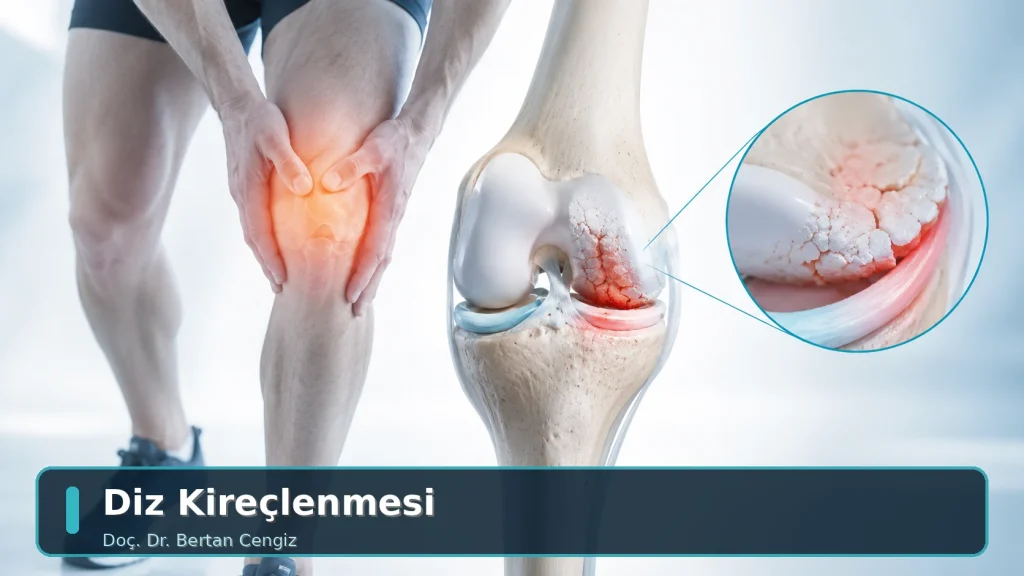
Knee Osteoarthritis (Gonarthrosis)
Knee osteoarthritis (gonarthrosis) is the gradual thinning of the cartilage covering the joint surfaces together with change throughout the joint as a whole. It is not simply «wear»; it is a process affecting cartilage, bone, the joint lining and the surrounding muscles together. It can be progressive, but the rate of progression varies greatly from person to person and can be slowed with treatment.
What Happens?
Healthy cartilage allows the joint surfaces to glide almost without friction. In osteoarthritis this tissue thins, its surface becomes irregular and its load-bearing capacity falls. In response, bony prominences (osteophytes) may develop at the edges, the joint lining can become inflamed from time to time and produce fluid, and the thigh muscles weaken.
An important point: the grade of osteoarthritis on an X-ray does not always match the severity of the pain. Some people with advanced X-ray findings have few symptoms, while others with mild findings have marked pain. Treatment is therefore planned according to the person’s symptoms and function, not according to the film.

Symptoms
- Knee pain that increases with activity and eases with rest
- Morning stiffness — generally lasting less than half an hour
- Difficulty going up and down stairs and squatting
- Pain and stiffness on the first steps after sitting for a long time
- Swelling, warmth and occasional fluid collection in the knee
- In later stages, angulation of the knee (inwards or outwards) and a shorter walking distance
Risk Factors
- Weight: directly increases the load on the knee and is the most effective modifiable factor.
- Age and genetic predisposition
- Previous meniscal or ligament injury, fractures extending into the joint
- Weakness of the muscles around the knee, particularly the quadriceps
- Alignment problems (varus/valgus)
- Occupations requiring heavy, repeated squatting and kneeling
Diagnosis
- History and examination: the nature of the pain, range of movement, alignment, joint fluid, muscle strength and gait assessment.
- Weight-bearing X-ray: more informative than a film taken lying down, because it shows the joint space under load.
- MRI: not routinely required; it is requested if there is an additional question such as a meniscal or cartilage lesion or locking.
Treatment
The foundation: exercise and weight management
The basis of treatment in knee osteoarthritis is muscle strengthening and regular movement. Strengthening the quadriceps reduces the load on the joint and can markedly affect pain. Low-impact activities such as walking, cycling and swimming are recommended; complete inactivity worsens joint health.
Weight loss is among the interventions with the strongest demonstrated effect on pain and function; even a small reduction markedly decreases the load on the knee.
Supporting treatments
- Pain management — the choice and duration of medication is determined by your physician
- Physiotherapy and range-of-movement work
- Appropriate footwear and, where needed, a stick (used on the opposite side) or a knee brace
- Intra-articular injection treatments in selected cases
Surgical options
Surgery is considered in cases that markedly restrict daily life, cause night pain and do not respond sufficiently to non-surgical treatment.
- Joint replacement (arthroplasty): replacing the damaged joint surfaces with artificial surfaces. The whole knee or only the affected compartment (partial replacement) may be treated. See: Joint Replacement Surgery.
- Corrective osteotomy: may be used in young patients with an alignment problem and osteoarthritis limited to one compartment, to shift load to the healthy side.
Arthroscopy is not a treatment for osteoarthritis. It does not provide the expected benefit in advanced disease; it may be considered only where there is a mechanical problem causing locking.
What Helps in Daily Life?
- Regular movement within the limits of pain — the “if it hurts I should not use it at all” approach makes things worse
- Avoiding staying in the same position for long; standing up and taking a few steps every hour
- Reducing squatting and kneeling work; choosing a high, stable chair
- Using a ramp or lift instead of stairs where possible
- Weight control and regular sleep
When Should You Seek Assessment?
- If pain interrupts your sleep at night
- If your walking distance has shortened markedly
- If there is recurrent swelling and fluid collection in the knee
- If a visible angulation has developed
- If symptoms persist despite exercise and pain management
When to Seek Medical Help Without Delay
- Redness, warmth and severe pain in the knee together with fever (this may indicate joint infection)
- Sudden severe pain preventing weight-bearing
- Obvious deformity after an injury
- One-sided pain, swelling and tenderness in the calf
These findings require urgent assessment. Outside office hours, go to the nearest emergency department.
Frequently Asked Questions
Can osteoarthritis be reversed?
Restoring thinned cartilage to its former state is not possible with today’s methods. However, this does not mean “nothing can be done”: muscle strengthening, weight control and pain management can markedly reduce symptoms and slow progression.
Does walking harm my knee?
No; on the contrary, regular walking within the limits of pain is recommended. Inactivity leads to muscle loss and joint stiffness, which increases symptoms. What is demanding is prolonged squatting, kneeling and high-impact activities that strain the knee.
Should I “wait until I am older” for a replacement?
The decision is not based on age alone; how much the pain restricts daily life, night pain, walking distance and the response to non-surgical treatment are assessed together. The aim is to be neither too early nor too late, and this is judged by examination and imaging.
Do intra-articular injections work?
They may help reduce symptoms in selected patients; however, they do not regenerate cartilage and their effect varies from person to person. Which treatment is appropriate for you is assessed by your physician according to the clinical picture.
Are supplements such as glucosamine useful?
The evidence for these products is debated and the results are not consistent. If you are considering them, it would be appropriate to consult your physician regarding interactions with your current medication.
Should I use a knee brace?
A brace can provide support and a sense of security in some patients. However, it does not replace muscle strengthening, and continuous use may reduce muscle activity. The decision and the type should be determined individually.
Academic Work
Assoc. Prof. Bertan Cengiz, MD has scientific work published in national and international peer-reviewed journals in the field of knee arthroplasty and degenerative joint disease and related areas. The publication list and verifiable academic sources are available on the Publications page.
Related Pages
- Joint Replacement Surgery (Knee, Hip and Shoulder Arthroplasty)
- Knee Arthroscopy
- Meniscus Tear
- Knee Replacement Aftercare and Exercise Guide
- Knee and Hip Problems
The information on this page is for general guidance and does not replace an in-person medical examination. Diagnosis and treatment require a physician’s clinical assessment. Outcomes of any treatment or surgical intervention may vary from person to person; no guarantee of a specific result or timeframe is given on this page.